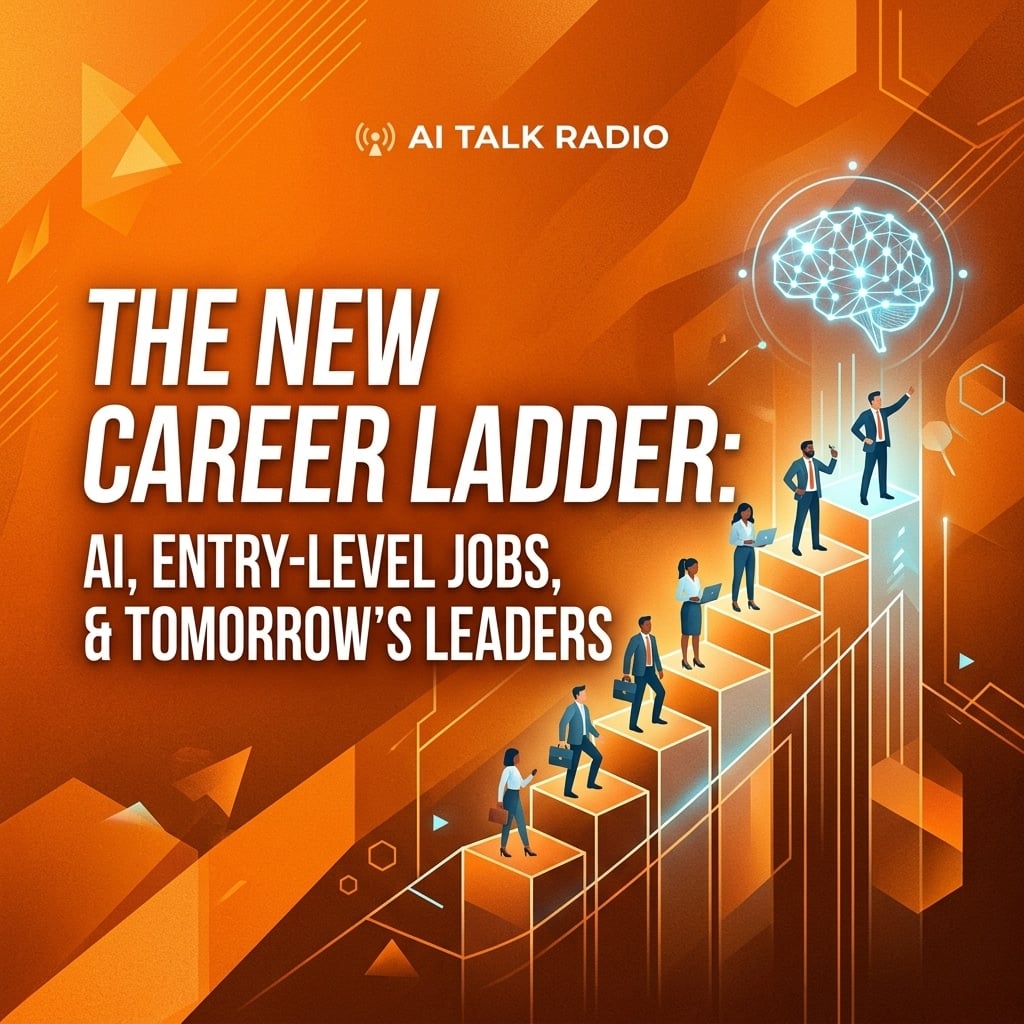
AI reshaping leadership skills is no longer just a future workplace theory. It is already changing how companies hire, train, promote, and prepare the next generation of workers.
The traditional corporate ladder is changing fast. For years, conversations around automation focused mostly on job loss. But the reality unfolding inside modern workplaces is more nuanced than that.
PwC’s 2026 Global AI Jobs Barometer found that AI-exposed junior roles are increasingly requiring skills once associated with more experienced professionals, including leadership, judgment, and strategic thinking. At the same time, the World Economic Forum reports that entry-level job postings in the U.S. have fallen sharply as companies adopt AI to handle foundational tasks such as data entry, basic coding, customer support, and administrative work.
That creates an important question for employers and job seekers alike: What happens when the work that used to train people is the first work to be automated?
For companies trying to build strong teams, this is no longer just a technology issue. It is a workforce development issue. It affects hiring, training, leadership pipelines, retention, and the future of entry-level opportunity.
Listen: AI Talk Radio Segment
Prefer to listen? Hear our short talk radio-style discussion on how AI is reshaping leadership skills, entry-level jobs, and the future of workforce development.
Runtime: approximately 4 minutes
The Real Disruption: From Job Loss to Experience Loss
Entry-level jobs have always served a purpose beyond basic production. They gave new workers the chance to build context.
Compiling reports, checking spreadsheets, sitting in on client calls, organizing schedules, supporting production teams, and learning from supervisors all helped early-career workers understand how business decisions are made. These tasks taught judgment, communication, timing, risk awareness, and problem-solving.
When AI absorbs too many of those baseline responsibilities, organizations risk creating an experience loss crisis.
Young professionals may be more comfortable with technology than any generation before them. Many already know how to use AI tools to draft, summarize, organize, research, and problem-solve. But technology fluency is not the same thing as workplace wisdom.
That wisdom comes from real-world exposure. It comes from learning why one decision works and another one fails. It comes from seeing how experienced leaders handle pressure, conflict, customer expectations, safety concerns, and changing priorities.
If companies treat AI only as a way to reduce cost or eliminate junior tasks, they may save time today while weakening tomorrow’s leadership pipeline.
How AI Is Reshaping Leadership Skills From the Top Down
AI is not only changing entry-level work. It is also changing what strong leadership looks like.
As more routine execution is supported by intelligent systems, human value shifts toward the skills technology cannot fully replace. Leaders are now expected to combine experience, emotional intelligence, technical awareness, and sound judgment.
This connects closely with the broader future-of-work conversation we explored in Kill Stacking and the Future of Work. The workplace is not simply asking people to do more tasks faster. It is asking people to think differently about how work is structured, supported, and improved.
As AI reshapes leadership skills, employers should pay close attention to three areas:
- Contextual discernment: Leaders must be able to review AI-generated answers and recognize what is missing, inaccurate, risky, or disconnected from real human needs.
- Trust and psychological safety: Teams need room to ask questions, test new tools, admit uncertainty, and learn without fear of embarrassment or punishment.
- Adaptability and learning speed: The best leaders will not be the ones who know every tool. They will be the ones who can evaluate change, guide people through it, and keep teams focused on the right outcomes.
Stanford HAI’s 2026 AI Index shows how quickly AI capability and organizational adoption are advancing. That means leadership development cannot wait until someone reaches management. Judgment, communication, and responsible technology use must be developed much earlier in a person’s career.
Entry-Level Jobs Are Becoming Career Launchpads
The answer is not to freeze entry-level jobs in the past. Employers do not need to protect every old task from automation. Instead, they need to redesign early-career roles so they still create learning, accountability, and growth.
This is especially important in industries where hands-on reliability, communication, and safety still matter every day. At American Workforce Group, we see this across light industrial, skilled trades, administrative, warehouse, manufacturing, and professional support roles. Technology can improve the process, but people still make the difference.
Employers who want to build stronger pipelines should think less in terms of a traditional career ladder and more in terms of a career launchpad. The goal is not just to fill a position. The goal is to give workers the right mix of structure, coaching, challenge, and opportunity so they can grow into larger responsibilities.
Three Ways Employers Can Build Stronger Talent Pipelines in the Age of AI
1. Design Entry-Level Roles Around Judgment, Not Just Tasks
If AI can create a basic report, summarize notes, or draft an email, the human role should move one step higher. Instead of asking a new employee only to produce the first draft, ask them to review the output, compare options, identify missing details, and explain their recommendation.
This helps entry-level workers build critical thinking while still learning how the work gets done.
2. Bring Back Mentorship in a More Intentional Way
For years, many employees learned by being near the work. They watched experienced people handle difficult conversations, solve problems, manage customers, adjust schedules, and make judgment calls.
As AI changes workflows, that natural “learning by observation” may happen less often. Employers should replace it with intentional mentorship, job shadowing, supervisor check-ins, and structured training.
This is where staffing and workforce partners can help. A strong staffing partner does more than send people to a job site. The right partner helps employers identify reliable candidates, communicate expectations clearly, and support long-term success. Learn more about AWG’s approach to staffing on our What We Do page.
3. Hire for Curiosity, Communication, and Coachability
Technical skills matter, but they are not the whole story. Strada’s research on entry-level hiring in the AI era found that employers continue to place high value on critical thinking, communication, collaboration, and workplace readiness.
That should encourage employers to look beyond perfect resumes. The strongest long-term hires are often people who are dependable, teachable, curious, and willing to grow.
That same principle is why temporary and temp-to-hire work can still be a powerful career pathway. As we shared in The Lease Mindset and Temp Jobs, short-term opportunities can become long-term stepping stones when workers and employers approach them with the right mindset.
What This Means for Job Seekers
For job seekers, AI is changing the expectations around entry-level work. Employers may still train, but they are also looking for people who can learn quickly, communicate clearly, and use tools responsibly.
If you are looking for work, this is a good time to focus on the skills that make you valuable in any workplace:
- Show up reliably and communicate early.
- Ask good questions and take feedback well.
- Learn new tools without losing attention to detail.
- Build real experience, even if the first opportunity is temporary.
- Look for roles where you can grow, not just roles that look perfect on paper.
American Workforce Group connects job seekers with opportunities across Southwest Washington and the surrounding region, including light industrial, skilled trades, administrative, warehouse, and professional support roles. If you are ready to take the next step, visit our Find Work page to learn how AWG can help.
The Human Element Remains the Ultimate Advantage
AI will continue to reshape how work gets done. It will change job descriptions, speed up workflows, and raise expectations for both leaders and entry-level employees.
But AI cannot replace the full formation of a dependable, thoughtful, experienced professional.
The future belongs to organizations that know how to combine new technology with human judgment. Employers who invest in training, mentorship, communication, and smart workforce planning will be better prepared for what comes next.
For businesses, that means building teams that can adapt. For job seekers, it means staying teachable, curious, and ready to grow.
At American Workforce Group, we help connect great people with great employers. Whether you are hiring for today’s workforce needs or building tomorrow’s leadership pipeline, AWG is here to help you move forward with confidence.
Need dependable people for your team? Learn more about our staffing solutions at What We Do or visit our home page to request talent.
Looking for your next opportunity? Start with our Find Work page and connect with a local AWG recruiter.
Related reading from American Workforce Group: